Showing posts with label Curiosities. Show all posts

Monday, 1 April 2013

And all for a mythical fountain


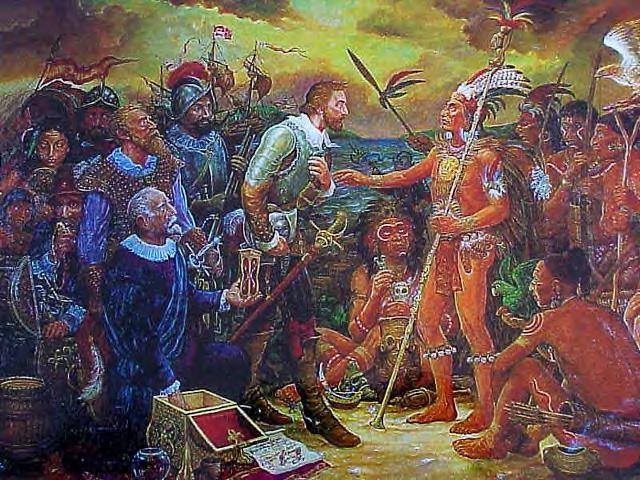
Five days ago, on the 27th of March, an anniversary unknown for many people took place. That day, 500 years ago, on the 27th of March of 1513, the Spanish explorer Juan Ponce de León arrived to the coast of a peninsula which he would call Florida. The peninsula was baptized with this name because of its lush forest and because, just like yesterday, that day was Easter Sunday, which in Spanish receives-among others- the name of Día de la Pascua Florida. Juan Ponce de León went on an expedition to discover the mythical fountain of youth in the misterious shallow pools of South Bimini, instead finding the southeast coast of Florida, and thus beginning the European history of the United States of America.

Fighting in his early years agains the Moors during the “Reconquista”, he joined Christopher Columbus on his second expedition to the New World (1493). He was named the provincial governor of the Eastern part of Hispaniola (modern-day Haiti and Dominican Republic) after suppresing an indian revolt. In 1508 he went to explore Borinquen (modern-day Puerto Rico) after the numerous reports of gold in the area. He would later be named governor of Puerto Rico. Shortly after, he heard the rumors of magical waters which could rejuvenate those who drank them. They could be found in a mysterious island called Bimini. Thus, he set on a journey to find those waters but instead landed on the coast of Florida. Juan Ponce de León went to Spain where he was named governor of Bimini and Florida and obtained permission to colonize those lands. However, when he arrived to Florida again in 1521 he was wounded with an indian arrow, and left for Cuba, where he soon died of the wound.

Despite being the official discoverer of Florida, there are reports that when they landed in the peninsula they found at least an indian who could speak a bit of Spanish, proving the existence of former expeditions probably in search of slaves.

I believe most Americans or British would answer Virginia to the question: ¿How did European history begin in the territory of modern U.S? Unfortunately if they were participating in a contest they would lose since Jamestown -first settlement of the Virginia colony- was founded in 1607.
The Spanish flag was set in Florida in 1513 and was lowered in 1821,a whopping period of 308 years! San Agustín, in Northeast Florida, is the oldest countinuously occupied European-established settlement and port in the continental U.S, and was founded by the Spanish admiral Pedro Menéndez de Avilés in 1565. If you go to the castle of San Marcos, you will still see the Cruz de Borgoña, a variant of the Cruz de San Andrés – which represents the martyrdom of St. Andrew the Apostle- and flag of the Spanish Empire in the XVI century. According to the historian from University of Florida, professor Michael Gannon, the first Thanksgiving Day took place in this city on September 8, 1565, when the Spaniards celebrated mass, communed and shared their food with the local Timucuan tribe. This is 57 years before the Thanksgiving Day of the British in Plymouth in 1621.
San Agustín was however, not the oldest settlement since there were three older ones which did not flourish and succeed. They were called: San miguel de Guadalupe (1526), Santa María de Filipino (1559) and Santa Elena (1560).

But the story doesn't stop in Florida. The Spaniards were the first Europeans encountering the river Mississippi -called río Espíritu Santo at the time- and Hernando del Soto claimed its basin to Spain in 1538. El Gran Cañón del Colorado (Arizona) was, once more, discovered by Spaniards.
What about Don Juan de Oñate? A native American born in Nueva España -now Mexico- in 1550. In 1595 Felipe II entrusted him with the mission to explore and colonize all the norther frontier of Nueva España. He forded all Río Grande – El paso is located there- in 1598 and claimed all this territory to Spain as Nuevo México. He later would found the province of Santa Fe. As many have put it, the history of the American Southwest cannot be understood without him. While this man, known as “the last of the conquistadors” is hardly remembered, Daniel Boone is a legend. However, it will be surprising for many to find out that this American pioneer adopted the Spanish nationality and was named commander of a distric in Missouri – which was part of an area at the time known as the Spanish Louisiana- by a Spanish governor. By the way, the Spanish Louisiana included territories such as the modern states of Oklahoma, Arkansas, Kansas, Nebraska, Iowa, Montana... And what about California? San Francisco, Los Ángeles o San Diego are examples of the Spanish pesence. For instance, San Diego and Monterey were founded by Gaspar de Portolá de Rovira, a Spanish soldier from Catalonia who became governor of Baja and Alta California.

In summary, to what was called the Virreinato de Nueva España, the following modern states belonged: California, Nevada, Colorado, Utah, Nuevo México, Arizona, Texas, Oregón, Washington, and parts of Idaho, Wyoming, North Dakota, South Dakota, Minnesota, Iowa, Missouri, Montana, Oklahoma, Kansas and Louisiana.

The original United States dollar was based on the Spanish dollar, which remained as legal tender in the U.S until 1857. According to Don J. M Prendes Pérez, the currency has Mexican origin. When they occupied part of the territory of New Spain, the Americans demanded these inhabitants a peso -the Spanish name for the coin used- as tribute. The locals called this tax dolor. The Pillars of Hercules – a Spanish design- are still present in the modern dollars. Even the American cowboy is just a copy of el vaquero español. The Spaniards took there pastoralism, transhumance, sheep, cows, pigs...and that is why many words have Spanish origin: sombrero, buckaroo (vaquero), Spanish saddle (silla de montar), chaps (chaparreras), corral, siesta...

But if there is something really unfare, is how the Spanish collaboration in the American War of Independence has been generally forgotten. While the role of France as an ally against Great Britan is remembered all the time, very few know that the independence was possible thanks to the financial and military help of Spain. At the time Spain still held the territories which now correspond to the states of Texas, Nuevo México and California plus Nueva Orleans. It also held a big portion of Latin America. Spain supported financially the colonies and had up to 20 000 soldiers fighting against Great Britain and holding the southern flank, supporting general Washington among others. Bernardo de Gálvez, governor of Louisiana, was famous for a campaign in 1779 without which Washington would have run in trouble. He cleared the port of Nueva Orleans and took the largest English base in the south, Pensacola (in May, 1781). The city of Galveston, in Texas, has its name. As a final curiosity, England offered Gibraltar back to Spain as long as Spain kept neutral in the war. It didn't happen, the Spaniards fought and Great Britain lost.

Once more the Spanish influence is greatly forgotten. If the Americans look back to their past, into their European origins, they will see that indeed their past is impregnated with Spanish presence. The Spanish flag has been waving in Florida for 308 years, the American flag has been waving for 237. And all began searching for a mythical fountain of youth.


Sunday, 2 December 2012

The lazy Spaniards

-->
Something people from other countries find interesting about the Spaniards is their daily schedules. I am sure every single Spaniard who has ever lived abroad or met other people while traveling have faced the tremendous curiosity of those who do not understand how we can possibly begin having lunch at 2 pm (and sometimes even finish at 4) all year round, and have dinner as late as 10 pm (or later) in summer. Why Spaniards do not usually go out before 11 pm or seem to have so much trouble to wake up in the morning as fresh as our peers in other countries. This is usually attributed to our Latin blood, the warmth and good weather in the south, the party and other similar nonsense and it serves to support the extended idea that Spaniards wake up late and they are lazy. I am sure there are many factors involved and those mentioned above may have played a little role, making our disorder increasingly acute over time but it turns out that we can actually go back in time and track the main responsible for our schedule disorder.

I am pretty sure i am not revealing anything surprising and unknown for most of you when i say that Spain's timezone is GMT+1 although according to its geographical location it should actually be GMT zone, like that of Portugal or UK. Of course Spain also has daylight savings like any other country in Europe and so our timezone in summer is GMT+2. The GMT system is a global time standard where the Greenwich Meridian is established to have longitude zero degrees. Since the Earth is 360º and the Earth revolves once every 24 hours, that means that theoretically we should have a different time zone every 15º (360/24). This also means that the world turns one degree longitude every 4 minutes (4*15=60min). However, this does not apply to the real world and it is not really adjusted to exactly 15º. We have to take into account geographical, economical and political reasons. Thus, very big countries such as India or China span more than 15º yet have only one time zone. The same accounts for Europe in which not all countries belong to the time zone that would correspond to them according to their geographical location. A clear example is Spain. The Greenwich Meridian crosses Spain at two locations: 42º 41' N, 0º 0' E (Huesca), and 38º 52' N, 0º 0' E (Denia, Alicante). This leaves pretty much the whole of Spain on the same zone as the UK and Portugal. Ok, so i probably haven't said anything so far that you didn't know before.


One might argue that this brings benefits since we have the same time as in almost the entire rest of Europe and that anyway, if we have always been adapted to this, what's the problem? But it turns out that the use of GMT+1 is relatively recent in history and if you look at it, it seems we definitely did not adapt to the change very well. We actually had the same time zone as our neighbour Portugal until 1940, just as it corresponds to our geographical location. But then world war II came and the nazis decided to impose their time zone to the countries they invaded, such as France or Belgium, which also used the time zone of UK at the time. The Spanish head of the state Francisco Franco, arguing the desirability of a national schedule which proceeds in accordance with the other European countries, decreed the advancement of legal time in 60 minutes ( click on the link to see the document). We were not the only ones and the UK actually did that too. However, the British lasted only until 1945 with this modified time zone while Spain continued with it until our days.

It turns out that my great grandparents were having lunch at the appropiate time, that is, at around 12-1 pm. We no longer do that simply because we prioritize daylight, proving that we never adapted to the new time zone. Spain is completely misplaced regarding its daylight. The whole idea of the time zones is to optimize the use of daylight so that, for instance, the official 12 pm is as close as possible to the local noon, the time when the sun is at the highest point above the southern horizon. This simply cannot happen in Spain. Geographically speaking it is very far from many of the countries of central Europe. This means that on the East of Spain, there is a difference of an hour with respect to what it should be in winter, and two in summer. Now think of the west part of Spain and this becomes two and three hours respectively. This means that the sunrise in Spain occurs later than in any other place (on the west in winter we get the first light at around 9) and the day already begins quite messed up. A person who wakes up at 7 am is effectively waking up at 6 am. It means we actually wake up quite early and sleep less than the actual recomended time by the WHO. We are having lunch at around 2-3 pm and dinner at 8-10 pm so we should actually start working at around 10 am, showing that our workday is too extended in the morning and falls short in the evening, or at least it should. I say it should because you have to take into account other things. Although the schedules relatively go in accordance with the official time, in our customs we prioritize the daylight, so many people still go to work later than in other European countries and therefore, leave work also later. Add to this the fact that after the civil war moonlighting became something unavoidable for many people. They would have a job in the morning until 2 pm and another in the evening until late in the night, For this reason, there is this very long lunch break which runs for 1-2 hours, which is extremely inefficient and useless. Conclusion: we hardly sleep and our workday becomes endless.

It is growing the idea that we should really get back to the time that corresponds to us given our location. Many people claim that GMT+1 is really imparing our competitiveness, being the main reason of our low productivity. Besides, people go to work when it is still night and this might be increasing the risk of traffic and occupational accidents. In summer what we have is endless days, which, due to our hot weather, become sometimes extremely horrible. Getting back to GMT+0 and a continues working time without break for the “desayuno de media mañana” or a 2 hours break for lunch would imply having much more time alocated to personal time rather than working time. We humans are made to be awake during daytime and rest during darkness. Making this changes would allow us to make a better use of natural light and many people believe that this would positively affect health as well as the productivity and efficiency of workers and companies. Besides, other side effects might be less accidents, less school failure and a better reconciliation of work and family.

In conclusion, to me there is no point in having the same time zone as countries in central and eastern Europe. There is no economic benefit at all and we are just absolutely messed up, suffering from sleeping abstinence, having less free time available and besides, giving the wrong idea to the rest of the countries that we are just lazy bastards who party and then have troubles to get up and work. Let's just look at Portugal. They did the experiment in the 90's of adapting to GMT+1 and the result was quite catastrophic. Their 4 years experiment was translated into worse exam results and failure at school plus an increase in stress and sleeping disorders such as insomnia. It brought more road accidents in the dark mornings and the households increased the energy expenditure. If it proved not to be valid in Portugal and we see quite similar things happening in Spain over the past 70 years, what are we waiting for? Besides we would have the same time in the whole of Spain and wouldn't have this aberrant situation in which the Peninsula is one hour ahead of the Canary Islands. I really wonder how many people would be eager to change it and go back to our right time zone. But whether some people like or not, it is obvious to me that we could only benefit from it. Just to conclude, next time you talk to a Spaniard and are about to say something like “mañana” or how lazy we are, no work only party, blah blah blah, think about this first :).